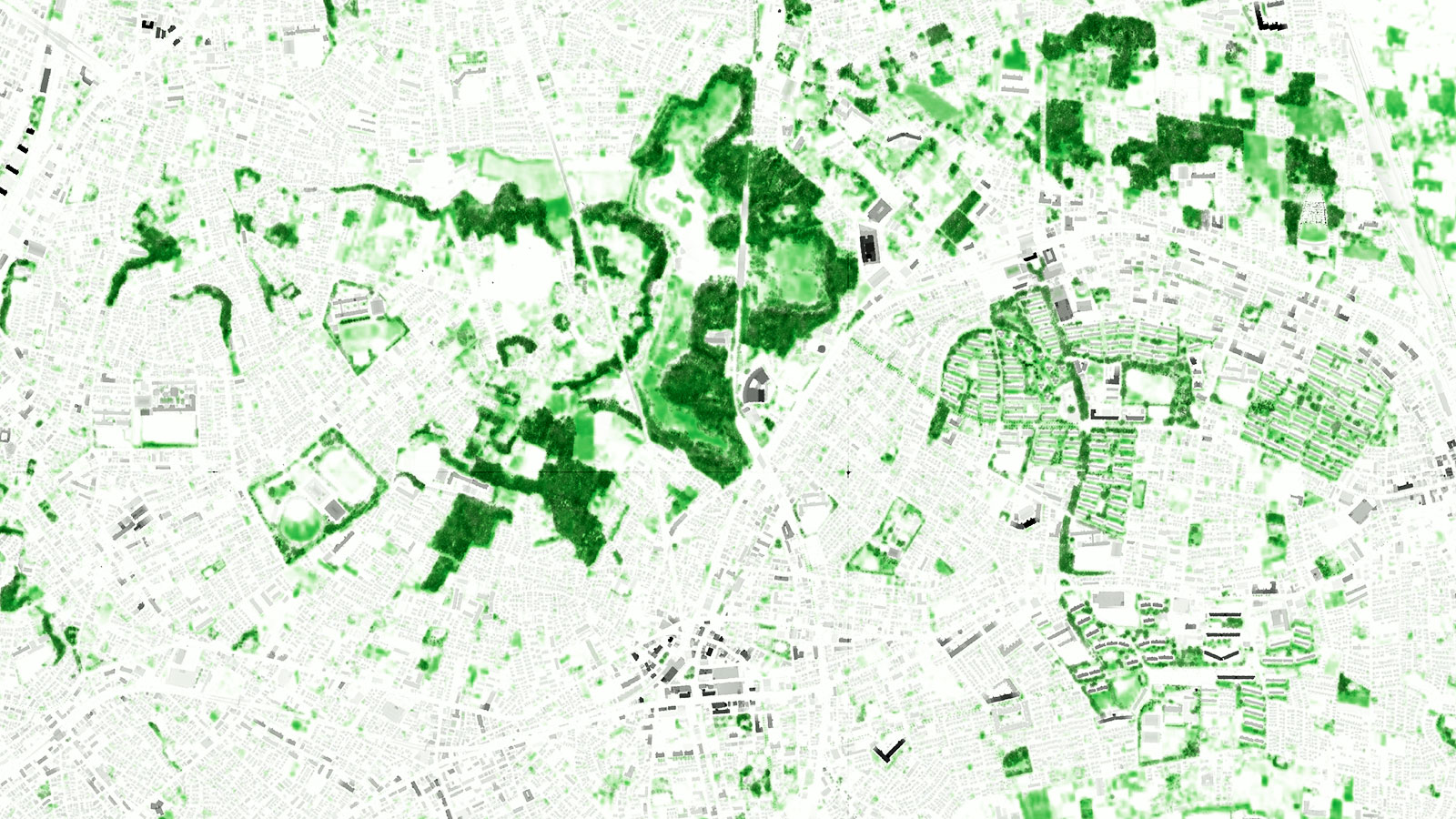
緑地については、その量や種類が高齢者の抑うつと関連すること、またその関連が都市部と農村部で異なる可能性を示してきました(Nishigaki et al., 2020)。さらに、近隣環境の美観や景観の質といった主観的評価が、脳構造や認知機能と関連することを示し、自然環境が心理的評価を介して健康に関与する可能性を示唆しています(Tani et al., 2023)。
地形、とくに居住地周辺の傾斜については、移動の負担要因である一方で、日常的な身体負荷や活動量と関係する環境要素として位置づけています。傾斜のある居住環境が糖尿病のコントロールやフレイルと関連することを示し(Fujiwara et al., 2017;Mori et al., 2022)、地形特性が高齢者の健康や機能状態の分布に関与する可能性を明らかにしてきました。
親水空間や大規模公園などの自然環境が、瞬間的なウェルビーイングと関連することを、スマートフォンを用いた経験サンプリング法により検討しています(Chen et al., 2025)。緑地研究で蓄積されてきた知見と並行して、水辺環境の健康影響を日本の都市・地域文脈の中で整理しています。
都市・空間デザインへの視座
緑地、水辺、地形といった自然環境を、健康都市・空間デザインに組み込むための基礎的エビデンスを提供します。地形や地理特性を前提とした地域評価の重要性を示すとともに、利用者の属性や身体条件に応じて、自然環境の価値をどのように活かすかを検討する視点が重要であると考えています。
Overview
This area examines how natural environments—green space, blue space, and local topography (undulation)—relate to health and behavior. We treat natural environments as psychological and sensory contexts as well as conditions that shape everyday physical demands, and aim to characterize their multidimensional health implications.
Detail
Studies have shown that both the amount and type of green space are associated with depressive symptoms among older adults, and that these associations may differ between urban and rural settings (Nishigaki et al., 2020). In addition, subjective evaluations of neighborhood beauty and landscape quality have been linked to brain structure and cognitive function, suggesting perceptual and psychological pathways through which natural environments may relate to health (Tani et al., 2023).
We also focus on residential slope as a topographical feature that can both increase mobility burden and provide habitual physical load. Prior work has reported associations between hilly environments and diabetes control as well as frailty among older adults (Fujiwara et al., 2017; Mori et al., 2022), indicating that topography may contribute to the distribution of health and functional status.
Furthermore, using smartphone-based experience sampling methods, we examine whether exposure to waterside spaces and large parks relates to momentary well-being (Chen et al., 2025). In parallel with evidence accumulated for green space, we position blue-space effects within Japanese urban and regional contexts.
Perspective for Urban / Spatial Design
This area provides foundational evidence for incorporating green and blue spaces and topography into healthy urban and spatial design. It underscores the importance of evaluating local environments while explicitly considering geographic conditions, and of designing environments that reflect differences in users’ attributes and physical capacity.
Selected Publications
- Tani, Y., Fujiwara, T., Sugihara, G., Hanazato, M., Suzuki, N., … & Kondo, K. (2023).
Neighborhood beauty and the brain in older Japanese adults.
International Journal of Environmental Research and Public Health, 20(1), 679. - Nishigaki, M., Hanazato, M., Koga, C., & Kondo, K. (2020).
What types of greenspaces are associated with depression in urban and rural older adults?
International Journal of Environmental Research and Public Health, 17(24), 9276. - Fujiwara, T., Takamoto, I., Amemiya, A., Hanazato, M., Suzuki, N., Nagamine, Y., … & Kondo, K. (2017). Is a hilly neighborhood environment associated with diabetes mellitus among older people? Results from the JAGES 2010 study. Social Science & Medicine, 182, 45-51.
- Mori, Y., Tsuji, T., Watanabe, R., Hanazato, M., Miyazawa, T., & Kondo, K. (2022). Built environments and frailty in older adults: A three-year longitudinal JAGES study. Archives of Gerontology and Geriatrics, 103, 104773.
- Chen, Y. R., Nakagomi, A., Hanazato, M., Abe, N., Ide, K., & Kondo, K. (2025). Perceived urban environment elements associated with momentary and long-term well-being: An experience sampling method approach. Scientific Reports, 15(1), 4422.